Ask someone in the United States to name a famous place in Canada and Niagara Falls usually shows up first.
Fair answer.
It is loud, massive and impossible to ignore.
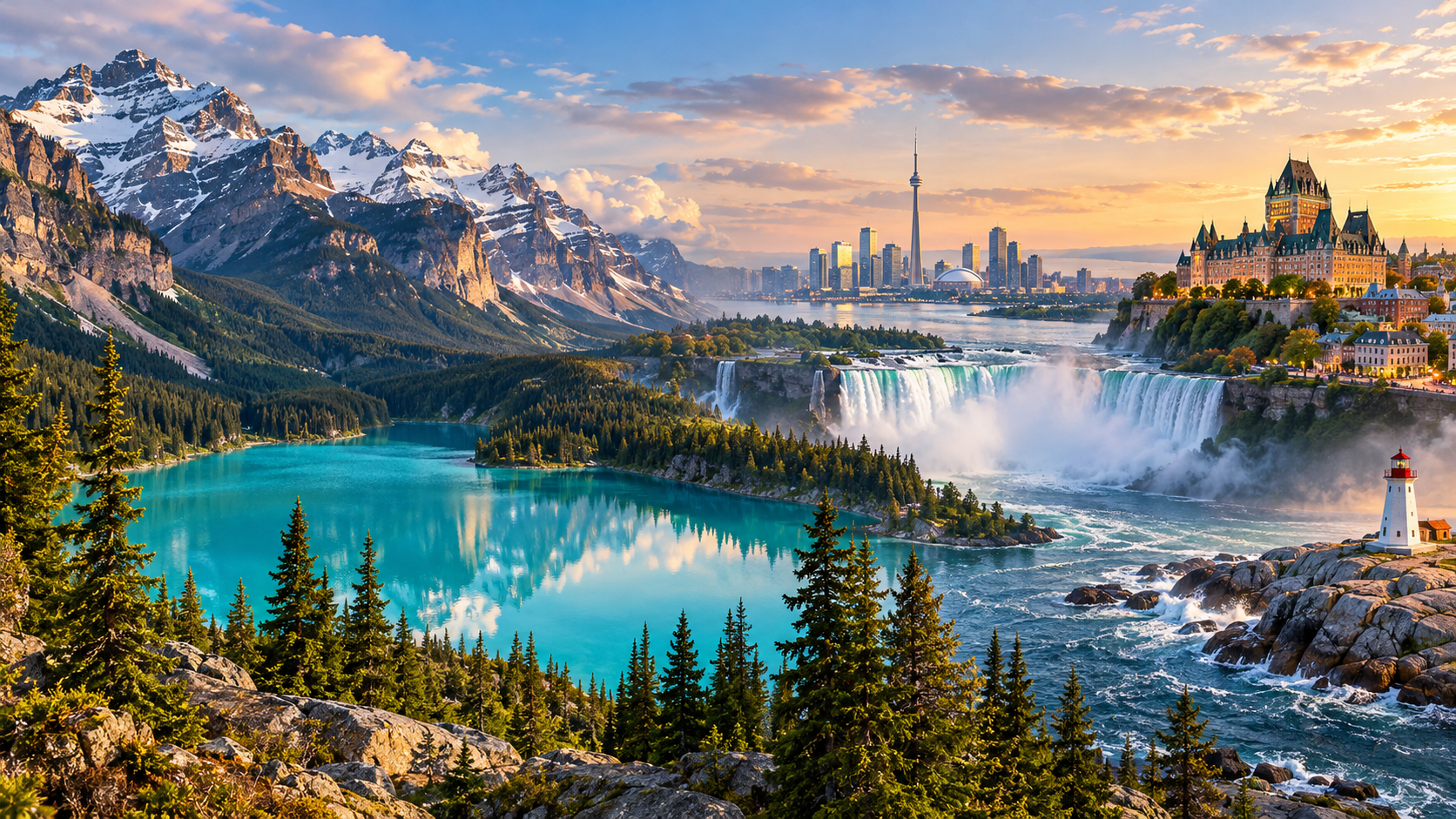
But Canada is also a country of turquoise mountain lakes, Arctic landscapes, walled historic cities, lighthouses, giant urban towers, fossil cliffs, fjords, old canals and coastlines where tides can completely change what the shore looks like in a matter of hours.
That is what makes Canada landmarks interesting.
There is no single visual style.
Toronto and Banff barely feel like they belong in the same travel brochure. Old Québec looks different from Vancouver. Newfoundland feels far removed from the Alberta Rockies. Even the word “nature” means something different depending on whether you are standing beside a glacier, a red-sand beach or a dark Atlantic cliff.
Canada is huge.
That sounds obvious, but travelers still underestimate it.
You cannot casually combine Vancouver, Banff, Toronto, Montréal and Newfoundland in one relaxed week.
The distances are real.
So the best way to think about Canada’s landmarks is by region.
| Landmark | Province or Territory | Best Known For |
|---|---|---|
| Niagara Falls | Ontario | Powerful waterfalls and classic viewpoints |
| CN Tower | Ontario | Toronto skyline and high city views |
| Old Québec | Québec | Historic walls, streets and French heritage |
| Banff National Park | Alberta | Rocky Mountains and turquoise lakes |
| Jasper National Park | Alberta | Wilderness, wildlife and mountain scenery |
| Bay of Fundy | New Brunswick/Nova Scotia | Extreme tides and coastal geology |
| Peggy’s Cove | Nova Scotia | Lighthouse and Atlantic granite coastline |
| Gros Morne | Newfoundland and Labrador | Fjords and dramatic geology |
If this is your first Canada trip, pick one or two regions and go deeper.
You will enjoy the trip much more.
Niagara Falls Is Famous for a Reason
Niagara Falls sits on the border between Canada and the United States.
The Canadian side is known especially for Horseshoe Falls, the largest of the three waterfalls in the Niagara system.
You hear it before you fully process the scale.
Water pours over the edge in an enormous continuous sheet, mist rises from below and the sound becomes part of the entire area.
This is one of those landmarks where photos do not really communicate the physical force.
You need to stand there.
The Canadian viewing areas offer broad perspectives over Horseshoe Falls and toward the American Falls across the river.
At night, colored illumination can make the area feel much more theatrical.
Touristy?
Absolutely.
Still worth seeing?
Also yes.
The Best Niagara Experience Is Not Just the Viewpoint
People often arrive, photograph the falls and leave.
That works if you are rushing.
But the better experience is seeing the falls from several levels.
- Walk the main Canadian promenade for the classic panoramic view.
- Get closer to the water through one of the established falls experiences.
- See the area after sunset when the crowds thin and the falls are illuminated.
- Leave time for the Niagara River and surrounding landscape, not only the busiest overlook.
- Bring something water-resistant because mist does not care about your outfit.
That final point becomes obvious very quickly.
Banff Looks Like Canada’s Screensaver Came to Life
Banff National Park is one of the places that shaped the global image of Canada.
Snowy mountains. Blue-green lakes. Dense forests. Wildlife crossing roads like they own the place.
They kind of do.
Banff lies in Alberta in the Canadian Rockies and forms part of the UNESCO-listed Canadian Rocky Mountain Parks.
The surrounding World Heritage property also includes Jasper, Kootenay and Yoho national parks along with several provincial parks.
The scenery was shaped by glaciers, erosion and mountain-building forces over enormous periods of time.
You do not need to know the geology to appreciate it.
The mountains handle the sales pitch themselves.
Lake Louise Is the Landmark Inside the Landmark
Lake Louise may be the most photographed location in Banff National Park.
Its water often appears an unreal turquoise color because of fine rock particles carried by glacial meltwater.
The lake sits beneath high mountain peaks and glaciers, creating the kind of view that makes people quietly stop walking for a second.
Then everybody takes out a phone.
It can get very busy.
That matters when planning.
Access, parking and shuttle systems may change by season, so check current arrangements rather than assuming you can simply drive to the lake whenever you feel like it.
Early mornings and shoulder seasons can feel much calmer.
Moraine Lake Is Equally Famous and Somehow Even More Dramatic
Moraine Lake sits in the Valley of the Ten Peaks and has become another symbol of the Canadian Rockies.
The lake’s color can be intensely blue, especially under clear light.
Mountains rise sharply behind it rather than sitting far in the distance.
The result feels compressed and dramatic.
Visitor access is managed because demand became overwhelming.
That is a good reminder for all major Canadian landmarks: national parks are not theme parks with infinite capacity.
Plan ahead.
Jasper Is Banff’s Wilder Relative
Jasper National Park covers more than 11,000 square kilometers and is the largest national park in the Canadian Rockies.
It generally feels more spread out than Banff.
The landscape includes mountains, lakes, waterfalls, valleys and a huge trail network.
Wildlife sightings are possible, though animals should always be given serious space.
Jasper is also known for dark skies.
On a clear night away from artificial light, the number of visible stars can be startling if you live in a bright U.S. city.
One practical note matters in 2026: the region is still dealing with impacts from the 2024 Jasper wildfire, so some areas may have closures or changed conditions.
Check before building a detailed route.
The Icefields Parkway Is a Landmark You Drive Through
The road connecting the Lake Louise area with Jasper is one of Canada’s most famous scenic drives.
The Icefields Parkway runs through high mountain landscapes with glaciers, lakes, waterfalls and viewpoints along the route.
This is not a drive you should schedule like an interstate transfer.
You will stop.
Repeatedly.
A journey that looks simple on a map can easily turn into a full day once viewpoints, short walks and lunch are involved.
And weather in the mountains can change fast.
Old Québec Feels Almost Too European for North America
Québec City is one of Canada’s most distinctive urban destinations.
The Historic District of Old Québec became a UNESCO World Heritage Site in 1985.
Its fortified walls, gates, narrow streets and historic buildings make it unusually well preserved.
In fact, Old Québec is the most complete surviving example of a fortified colonial town north of Mexico.
Upper Town sits above the St. Lawrence River on Cap Diamant, while Lower Town grew around the harbor and Place Royale.
Walking between them gives you a much stronger sense of the city’s age than simply photographing one famous building.
Château Frontenac Is Basically Québec City’s Skyline
Even travelers who do not know its name often recognize Château Frontenac.
The enormous hotel rises above the St. Lawrence River with turrets, steep roofs and a silhouette that looks almost castle-like.
It is not a medieval castle.
It was built much later as a grand railway hotel.
Still, visually, it dominates Old Québec.
The nearby Dufferin Terrace offers broad river views and is one of the easiest places to understand the city’s dramatic location.
CN Tower Is Toronto’s Obvious Landmark
Toronto’s skyline changes quickly, but the CN Tower still anchors it.
The tower rises more than 550 meters above the city and was once the world’s tallest free-standing structure.
Today its biggest appeal for visitors is simple.
The view.
From the observation levels, Toronto spreads across a massive grid beside Lake Ontario.
On a clear day, you finally understand how flat and extensive the city really is.
The tower is especially striking around sunset when daylight turns into city lights.
That is also when everybody else has the same idea.
Toronto’s Skyline Works Better From Across the Water
Sometimes the most famous landmark is best viewed from somewhere else.
Toronto Islands offer one of the classic skyline views back toward downtown and the CN Tower.
The short trip across the harbor changes the atmosphere completely.
You move from dense downtown towers to beaches, paths and green space while keeping the city directly across the water.
If you’re visiting in pleasant weather, this combination works better than spending an entire day inside downtown buildings.
Parliament Hill Defines Ottawa’s Core
Ottawa is Canada’s capital, and Parliament Hill is its most recognizable architectural landmark.
The Gothic Revival buildings sit above the Ottawa River and create a formal center for the city.
The area’s towers, lawns and river setting make it visually different from Toronto or Montréal.
Nearby attractions include major national museums, the Rideau Canal and historic central neighborhoods.
Ottawa often gets treated as a day trip or administrative city.
Give it a little more credit.
Rideau Canal Changes With the Season
The Rideau Canal connects Ottawa with Kingston and is one of Canada’s UNESCO World Heritage properties.
It was built in the 19th century and remains an important example of a historic canal system.
In Ottawa, the canal runs right through the city.
During warmer months it becomes part of the urban landscape for walking, cycling and boating.
In cold winters, sections may freeze enough for skating when conditions permit.
That seasonal switch feels extremely Canadian.
The same landmark goes from waterway to winter recreation space.
Montréal’s Notre-Dame Basilica Brings the Drama Indoors
Old Montréal is full of stone buildings and historic streets, but Notre-Dame Basilica usually becomes the visual highlight.
The interior is far more dramatic than the exterior suggests.
Deep blue tones, carved wood, gilded details and a huge vaulted ceiling create an almost theatrical effect.
It is one of those interiors where people instinctively lower their voices even when nobody told them to.
Outside, Old Montréal extends toward the historic port and gives you another side of the city from the modern downtown towers nearby.
Vancouver Has One of the Most Unfairly Good City Settings
Mountains behind the skyline.
Ocean beside downtown.
Forested parks within the city.
Vancouver’s geography does a lot of the work.
One of the essential landmarks is Stanley Park, a huge urban park occupying a peninsula immediately beside downtown.
The seawall gives you changing views of water, mountains, beaches and city skyline.
It is less a single landmark than a full loop of “okay, this city got lucky.”
The Totem Poles at Brockton Point Need Context
Stanley Park includes a well-known collection of totem poles at Brockton Point.
They are among the most visited attractions in British Columbia.
But they should not be treated as generic “Canadian Indigenous art.”
Totem poles belong to specific First Nations traditions of the Northwest Coast.
Different nations have their own histories, styles and meanings.
Canada’s Indigenous cultures are extremely diverse.
That matters anywhere you encounter Indigenous cultural sites or objects.
Peggy’s Cove Is the Classic Atlantic Canada Image
A white-and-red lighthouse standing on smooth granite beside the Atlantic.
That is Peggy’s Cove.
The Nova Scotia fishing community has become one of eastern Canada’s most recognizable coastal landmarks.
The landscape is simple but dramatic: exposed granite, ocean, low buildings and changing weather.
The sea can be dangerous.
Visitors should respect warning signs and avoid wet, dark rocks near the water, where waves can be unpredictable.
A good photo is not worth testing the Atlantic.
The Bay of Fundy Makes the Ocean Look Broken
The Bay of Fundy lies between New Brunswick and Nova Scotia and is famous for some of the highest tides on Earth.
The difference between high and low tide can completely change the shoreline.
At places such as Hopewell Rocks in New Brunswick, huge rock formations may be surrounded by water at high tide and accessible from the ocean floor area when the tide is out.
That before-and-after experience is the attraction.
If you only see one tide stage, you are seeing half the story.
Hopewell Rocks Are Canada’s Most Obvious Tide Lesson
These sandstone formations have been carved by erosion into unusual shapes sometimes called flowerpot rocks.
At low tide, visitors can walk on the exposed seafloor around them when access is permitted.
Hours later, water can fill the same area.
Check tide schedules carefully.
This is one destination where timing is not a suggestion.
Gros Morne Looks Like Newfoundland Showing Off
Gros Morne National Park in Newfoundland is a UNESCO World Heritage Site known for extraordinary geology and dramatic landscapes.
There are fjords, mountains, coastal lowlands and exposed rocks that helped scientists understand plate tectonics.
Western Brook Pond is one of the most famous areas, with steep cliffs rising around a long freshwater fjord-like lake.
The park feels different from the Rockies.
Less polished.
More Atlantic.
And often moodier.
L’Anse aux Meadows Rewrites the Usual North American Timeline
At the northern tip of Newfoundland sits L’Anse aux Meadows National Historic Site.
The archaeological site contains evidence of a Norse presence in North America around the year 1000.
That places European activity here centuries before Columbus’s first voyage.
UNESCO recognized the site in 1978.
The landscape is remote, windswept and remarkably understated considering the historical significance.
There is no giant monument trying to tell you this is important.
The archaeology does that quietly.
The Canadian Badlands Look Like Someone Swapped Countries
Not every Alberta landmark has glaciers.
Dinosaur Provincial Park is a completely different landscape.
Badlands, exposed rock, dry valleys and fossil beds replace the mountain scenery farther west.
The park is one of Canada’s UNESCO World Heritage properties and is internationally important for dinosaur fossils.
It is also visually strange in the best way.
If your picture of Canada is pine trees and snow, this place will correct it fast.
Head-Smashed-In Buffalo Jump Tells an Older Canadian Story
Canada’s landmark story does not begin with European settlement.
Head-Smashed-In Buffalo Jump in Alberta preserves evidence of Indigenous hunting practices used over thousands of years.
Plains peoples used knowledge of bison behavior and the landscape to drive animals toward cliffs as part of coordinated communal hunts.
The UNESCO-listed site helps explain technology, food systems, social organization and relationships with the land long before modern Canada existed.
It deserves more attention than it usually gets in basic travel lists.
Canada’s Landmarks Are Better When Indigenous History Is Included
Many famous landscapes sit within the traditional territories of Indigenous peoples.
National parks, mountains, rivers and coastal areas did not become meaningful when tourism arrived.
They already had names, stories, trade routes, spiritual significance and practical importance.
A better Canada trip includes that context.
- Look for local First Nations, Inuit or Métis cultural centers where available.
- Read the Indigenous place names and interpretation at parks and historic sites.
- Remember that Indigenous cultures are not one single Canadian tradition.
- Support Indigenous-led tours or cultural experiences where practical.
- Treat sacred or culturally important places with the same respect you would give a major religious site.
Travel gets more interesting when the story gets longer.
When Is the Best Time to See Canada Landmarks?
That depends almost entirely on region.
Summer is the easiest season for the Rockies, Atlantic Canada and long road trips.
Fall can be spectacular in Ontario, Québec and parts of the Maritimes.
Winter gives Québec City, Ottawa and mountain destinations a completely different personality.
Spring can bring lower crowds but unpredictable conditions.
| Season | Best For | Main Catch |
|---|---|---|
| Spring | Cities, shoulder-season travel | Unpredictable rain, snow or mud |
| Summer | National parks, road trips, Atlantic Canada | Higher prices and crowds |
| Fall | Autumn color, cities, cooler hiking | Shorter days later in season |
| Winter | Snow scenery, skating, skiing | Cold and weather disruptions |
One country can easily contain beach weather, mountain snow and cold rain on the same week.
Canada enjoys making packing complicated.
How Long Do You Need for a Canada Landmark Trip?
This is where geography wins.
If you have one week, pick one region.
For example:
- Toronto, Niagara Falls and Ottawa for an easy central Canada route;
- Montréal and Québec City for culture, food and historic urban landmarks;
- Banff and Jasper for a Rockies-focused trip;
- Vancouver and nearby coastal destinations for western scenery;
- Nova Scotia and New Brunswick for Atlantic landmarks;
- Newfoundland for Gros Morne and L’Anse aux Meadows with enough travel time.
Trying to connect all of those in seven days would mostly create airport memories.
Which Canada Landmarks Are Best for a First Trip?
If you want the classic shortlist, five places cover very different versions of Canada.
Niagara Falls gives you the famous natural spectacle.
Old Québec gives you historic city atmosphere.
Toronto brings the big modern skyline.
Banff gives you the Rockies.
Vancouver adds Pacific scenery and a very different urban setting.
That is already enough for several trips.
FAQ About Canada Landmarks
What is the most famous landmark in Canada?
Niagara Falls is probably Canada’s most internationally recognized natural landmark. The CN Tower, Banff National Park and Old Québec are also among the country’s most famous places.
How many UNESCO World Heritage Sites does Canada have?
As of 2026, Canada has 22 properties on the UNESCO World Heritage List, including cultural and natural sites across the country.
What is the most famous landmark in Toronto?
The CN Tower is Toronto’s most recognizable landmark and remains the defining feature of the city’s skyline.
What are the most famous landmarks in the Canadian Rockies?
Lake Louise, Moraine Lake, the Icefields Parkway, Banff National Park and Jasper National Park are among the most famous Rocky Mountain destinations.
Is Old Québec a UNESCO World Heritage Site?
Yes. The Historic District of Old Québec was added to the UNESCO World Heritage List in 1985 and is one of North America’s best-preserved fortified historic urban areas.
What landmarks should you see in Atlantic Canada?
Peggy’s Cove, the Bay of Fundy, Gros Morne National Park, Old Town Lunenburg and L’Anse aux Meadows are among the strongest options.
How many days do you need to see Canada’s major landmarks?
There is no realistic short trip that covers all of them. Seven to ten days works well for one region, while several weeks are needed for a broader coast-to-coast itinerary.
Canada’s Best Landmarks Are Really About Scale
Canada does scale very well.
Sometimes almost unfairly well.
A waterfall is not simply a waterfall. It becomes Niagara.
A mountain lake is not simply pretty. It sits beneath glaciers in Banff.
A city park in Vancouver can feel like wilderness while downtown towers remain visible across the water.
A historic district in Québec still carries fortifications around streets that have been lived in for centuries.
And on the Atlantic coast, the ocean itself can appear to move miles away between tides.
That scale is the thread connecting many Canada landmarks.
But the smaller details matter too.
A quiet side street in Old Québec before breakfast.
A cold morning beside Lake Louise before most visitors arrive.
The sound of waves hitting granite at Peggy’s Cove.
A train moving through Toronto while the CN Tower disappears between buildings.
A dark night in Jasper when the stars suddenly look much closer than they should.
Those are the moments that turn a famous landmark into an actual memory.
So do not build a Canada trip by counting attractions.
Pick a region.
Leave travel time.
Check current park access.
Learn whose traditional land you are visiting.
And give the big landscapes enough time to feel big.
Canada is not a country that rewards rushing.
It is simply too large for that.