Laos looks fairly small on a map of Southeast Asia.
That can create the wrong impression.
The country has a population of roughly eight million people, yet its cultural landscape is remarkably varied. Different communities speak different languages, wear distinctive textiles, follow different religious traditions and live in environments ranging from Mekong River valleys to remote mountain villages.
So when people search for laos people, there is an important thing to understand right away.
There is no single Lao lifestyle.
A family living in Vientiane may have a very different daily routine from a Hmong household in the northern highlands. A Khmu village may have customs that differ from those of lowland Lao communities. Even food, clothing and celebrations can change significantly between regions.
At the same time, there are shared cultural threads.
Rice matters. Family matters. Community gatherings matter. Buddhist temples shape life in many towns and villages. Music, weaving, religious ceremonies and hospitality remain visible even as cities modernize and younger generations spend more time online.
That mix is what makes Laos interesting.
Tradition is not sitting in a museum.
It is still part of ordinary life.
Who Are the People of Laos?
Laos is one of Southeast Asia’s most ethnically diverse countries.
The government officially recognizes 49 ethnic groups, while within those broad categories there are many smaller communities and linguistic traditions.
The ethnic Lao form the largest single group and are especially concentrated in lowland areas along the Mekong River and its tributaries.
Other large communities include the Khmu and Hmong, along with Phouthay, Tai, Lue, Akha and many others.
Older travel books sometimes divided people into categories such as Lao Loum, Lao Theung and Lao Soung, basically grouping communities according to elevation.
You may still see those terms.
But they can flatten a much richer reality.
People usually identify with specific ethnic, linguistic and local communities rather than simply saying, “I belong to the mountain category.”
| Community | General Background | Where You May Encounter Them |
|---|---|---|
| Lao | Tai-Kadai-speaking majority group | Mekong lowlands, cities and much of central Laos |
| Khmu | Austroasiatic-speaking communities | Especially northern and upland areas |
| Hmong | Hmong-Mien-speaking communities | Mountain regions in northern and central Laos |
| Tai and Phouthay groups | Related Tai-speaking communities | Various valleys and lowland regions |
| Lue | Tai-speaking community with distinct traditions | Mainly northern Laos |
| Akha | Tibeto-Burman-speaking community | Mountainous northern provinces |
This diversity becomes especially obvious if you travel outside the main tourist route.
Clothing changes.
House styles change.
Languages change.
Even the rhythm of village life can feel different.
Lao Is the Official Language, but It Is Not the Only Language
Lao is the official language of the country.
It belongs to the Tai language family and is closely related to Thai, especially the language spoken in northeastern Thailand.
Lao uses its own script, which has a rounded appearance and developed from older regional writing traditions.
In Vientiane, Luang Prabang and other urban centers, Lao is the common language of schools, administration, media and daily business.
But many people grow up speaking another language at home.
Khmu, Hmong, Akha and other ethnic communities maintain their own languages.
Some people are multilingual by necessity.
They may speak a local ethnic language with family, Lao in school or business and perhaps some Thai, English, Chinese, Vietnamese or French depending on work and location.
For travelers, learning a few Lao words helps.
A simple greeting and thank you go a long way.
As usual, perfect pronunciation is less important than making an effort.
Family Is the Center of Everyday Life
Family relationships carry a lot of weight in Laos.
Extended families may live together or close to one another, particularly outside major cities.
Grandparents, aunts, uncles and cousins can be deeply involved in everyday life.
Meals are often shared.
Important decisions may involve several relatives rather than only one individual.
Older family members usually receive strong respect.
That respect shows up in language, body posture and social behavior.
This does not mean every Lao household functions in the same traditional way.
Urbanization, migration, education and modern employment are changing family structures, especially among younger people.
Still, family obligations often remain stronger than many Americans are used to.
If a relative needs help, it may be understood as a family responsibility rather than a personal choice.
Villages Still Matter a Lot
Although Laos is urbanizing, a large share of the population still lives outside major cities.
Village life may revolve around agriculture, family networks, temples and communal events.
Rice farming has historically been central to rural life.
In lowland areas, wet-rice cultivation is common.
In mountain regions, agricultural practices can differ depending on terrain, rainfall and local traditions.
Daily schedules may follow daylight and agricultural seasons more closely than the clock.
Planting and harvest periods shape community activity.
So do weddings, Buddhist festivals, funerals and ceremonies.
That does not mean rural Laos is frozen in time.
Motorbikes, smartphones, social media and modern construction are normal parts of life in many villages now.
A wooden house may have satellite television.
A farmer may check Facebook during lunch.
Tradition and technology happily occupy the same space.
Vientiane Shows the Urban Side of Lao Life
Vientiane is the capital and largest urban center.
By American standards, it can still feel fairly relaxed.
Traffic exists, obviously, but the city does not have the relentless pace of Bangkok or Ho Chi Minh City.
Cafés, offices, restaurants, markets and shopping centers are part of everyday life.
Young professionals increasingly work in service industries, tourism, business and technology rather than agriculture.
International influences are also easier to see.
You will find Korean restaurants, Thai products, French-style bakeries, international coffee chains and contemporary fashion alongside traditional markets and Buddhist temples.
That mixture is modern Laos.
It is not a battle between old and new.
People simply use both.
Theravada Buddhism Shapes Much of Lao Culture
Theravada Buddhism is the most prominent organized religion in Laos and has a strong cultural role among ethnic Lao and several other communities.
Temples, known as wat, are often central landmarks in towns and villages.
Monks wear saffron or orange robes and participate in ceremonies, festivals and community life.
Many Lao men spend some period as monks or novices, though this varies by family and individual.
Giving food or other necessities to monks is considered a form of merit-making.
Visitors notice this most visibly in Luang Prabang, where morning alms-giving has also become a tourist attraction.
But there is a nuance.
This is a religious practice first.
It is not a sunrise photo shoot designed for visitors.
If you watch or participate, follow local guidance, stay quiet and keep respectful distance.
Buddhism and Spirit Beliefs Can Exist Side by Side
Lao spiritual life is not always divided neatly into categories.
Buddhist beliefs may exist alongside older traditions involving spirits, ancestors and protective forces.
This is common across much of Southeast Asia.
A family may visit a Buddhist temple, make offerings to monks and also take part in a ceremony connected with protective spirits or ancestors.
For some ethnic communities, animist beliefs remain especially important.
So it is misleading to imagine that everyone follows one religious system in exactly the same way.
Actual belief tends to be more layered.
The Baci Ceremony Is About Keeping Life in Balance
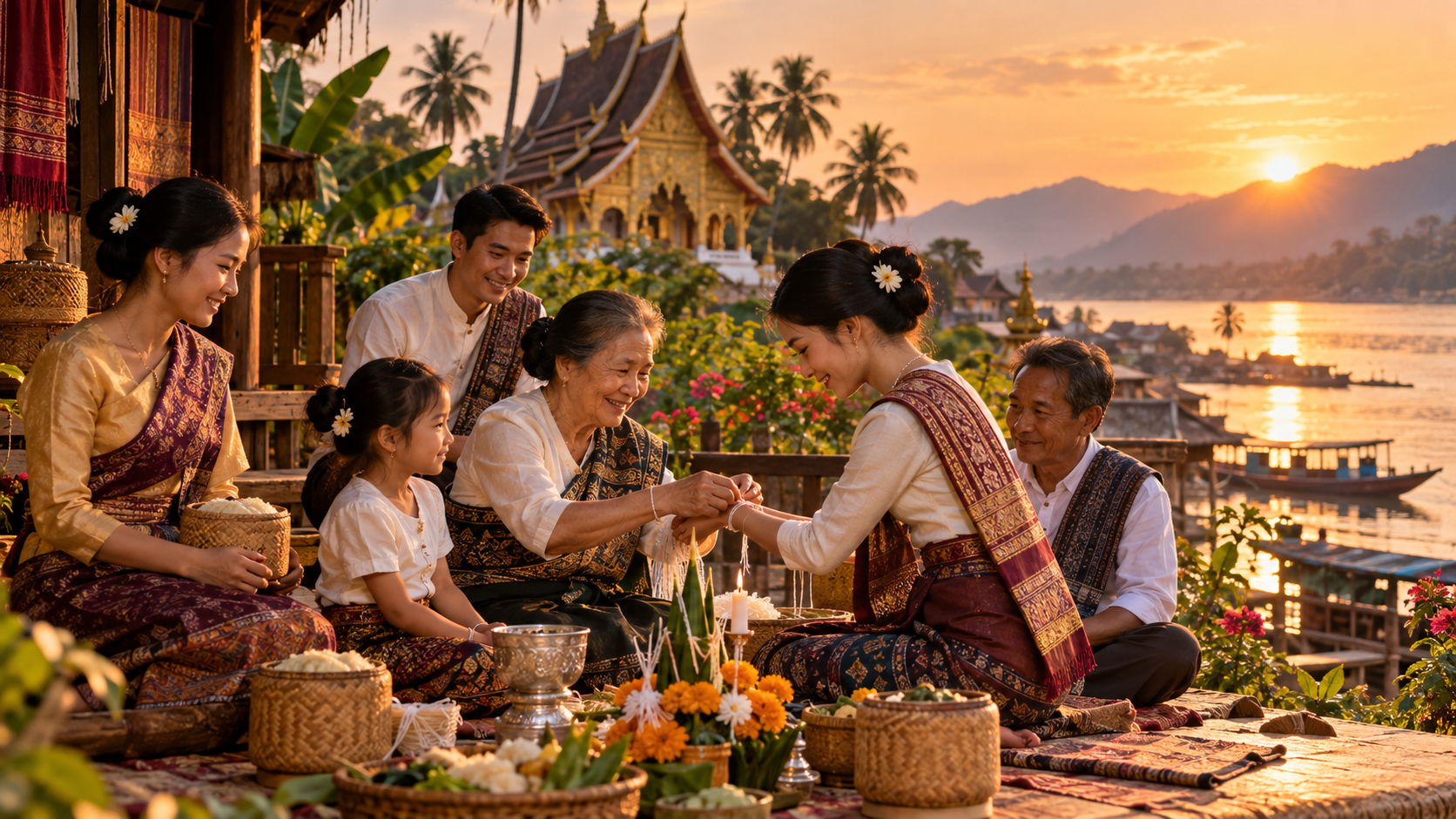
One of the best-known Lao ceremonies is baci, also called sou khuan.
It may be held for weddings, births, departures, returns, illness, important guests or major life transitions.
The ceremony is connected with the idea of calling and strengthening a person’s khuan, often explained as vital spirits or aspects of a person’s wellbeing.
White cotton strings are tied around the wrists while good wishes are spoken.
Those strings may stay on for several days.
If a Lao family invites you to a baci ceremony, it is usually a meaningful gesture.
Do not immediately cut off the strings because they clash with your watch.
Sticky Rice Is Almost a Cultural Character of Its Own
Food tells you a lot about Laos.
And sticky rice tells you more than almost anything else.
Known as khao niao, glutinous rice is a major staple, particularly among ethnic Lao communities.
It is traditionally steamed and served in small woven bamboo baskets.
People often eat it with their hands, rolling a small amount into a ball and using it to pick up other foods.
Meals are usually communal rather than arranged as one individual plate with separate portions.
Dishes go in the center.
Everyone shares.
That eating style reflects the social character of meals.
Food is not simply fuel.
It is time together.
What Do People in Laos Eat?
Lao cuisine tends to combine fresh herbs, fermented flavors, chile, grilled foods and sticky rice.
It can be bright, salty, sour, smoky and very spicy.
If you think Lao food is simply a quieter version of Thai food, a few meals will fix that idea.
- Larb is a minced meat or fish dish mixed with herbs, lime and seasonings.
- Tam mak hoong is Lao-style green papaya salad, often intensely savory and spicy.
- Khao niao, or sticky rice, accompanies many meals.
- Jeow refers to dipping sauces that may contain chile, herbs, tomato, eggplant or other ingredients.
- Mok dishes are seasoned ingredients wrapped and steamed, often in banana leaves.
- Grilled fish, chicken and pork are common in markets and roadside restaurants.
Fresh herbs are not decoration.
They are part of the dish.
Larb Is More Than Something on a Restaurant Menu
Larb is one of the dishes most strongly associated with Lao identity.
It can be made with meat, fish or other ingredients and seasoned with herbs, lime, chile and toasted rice powder.
Recipes vary.
Some versions are cooked. Others may involve different preparation traditions.
The dish appears at family meals and celebrations and has strong cultural associations with good fortune.
In 2026, larb is also part of an ongoing UNESCO intangible heritage nomination process.
That does not mean one recipe has suddenly become official.
Quite the opposite.
Its importance comes partly from the many community traditions surrounding it.
Music Is Something People Participate In
The khaen is one of the most recognizable Lao musical instruments.
It is a mouth organ made from bamboo pipes fitted with reeds.
The sound can be rich and surprisingly full for such a simple-looking instrument.
Khaen music appears at village festivals, songs, dances and ceremonies.
UNESCO added khaen music of the Lao people to its Representative List of the Intangible Cultural Heritage of Humanity in 2017.
One interesting feature is participation.
The audience is not always expected to sit quietly while performers do everything.
People may join songs and dances.
Music becomes social rather than purely performative.
Lamvong Is the Dance You May Actually Be Invited to Join
Lamvonglao is a traditional social dance performed widely at weddings, festivals, formal events and family celebrations.
UNESCO added it to its Representative List in 2024.
Men and women typically dance in circular formations using controlled hand and foot movements.
The pace is graceful rather than frantic.
You do not need professional dance training.
Which is good, because if you stay in Laos long enough, somebody may eventually expect you to try.
Watch the people beside you.
Copy gently.
Confidence can arrive later.
Textile Traditions Tell You Where People Come From
Traditional clothing and weaving vary significantly between ethnic communities.
Patterns, colors and techniques can communicate local identity, family tradition and cultural symbolism.
Among many Lao women, the sinh – a woven tube skirt – remains one of the most recognizable traditional garments.
It may be worn during ceremonies, at work or for formal events depending on style and context.
Some textiles are extremely detailed.
Silk weaving is especially associated with certain regions and communities.
Natural dyes may come from plants and other local materials.
This is not mass-produced “ethnic print.”
The techniques can carry generations of knowledge.
Naga Motifs Carry Meaning Beyond Decoration
The naga, a serpent-like figure found across mainland Southeast Asian traditions, appears frequently in Lao textiles and religious imagery.
Traditional Naga motif weaving in Lao communities was added to UNESCO’s Representative List in 2023.
The motif is associated with protection, ancestors and cultural identity.
It can appear on garments used during different stages of life and during ritual events.
Women have played a particularly important role in passing weaving knowledge from one generation to another.
So when you look at a beautiful woven textile, you’re not only looking at color and geometry.
There may be a story sitting inside the pattern.
Respect Is Often Shown Quietly
Lao social behavior can feel gentle compared with the more direct style common in the United States.
Open confrontation may be avoided.
Public anger can make people uncomfortable.
Maintaining calm and preserving social harmony often matter.
This does not mean people never disagree.
Of course they do.
They may simply express disagreement less directly.
For an American visitor, this can be easy to misread.
A polite smile does not always mean enthusiastic agreement.
Sometimes it just means, “We are going to keep this interaction pleasant.”
The Head and Feet Have Different Social Meanings
Traditional etiquette across Laos often treats the head as the highest and most respected part of the body.
Avoid casually touching someone’s head.
Feet are considered lower and less respectful.
Do not point the soles of your feet toward people, religious images or monks.
When sitting on the floor in a temple, position your feet away from sacred objects.
These habits become automatic quickly once you notice them.
Temple Etiquette Is Pretty Simple
You do not need a handbook.
A few basic habits cover most situations.
- Dress modestly when entering Buddhist temples.
- Remove shoes when required before entering temple buildings or homes.
- Do not climb on religious structures for photos.
- Avoid touching monks, especially when local customs discourage physical contact between monks and women.
- Keep your voice low in active religious spaces.
- Ask before photographing people during ceremonies.
Basically, treat a temple like a place people actually believe is sacred.
Because they do.
Weddings Can Become Major Community Events
Lao weddings may include Buddhist elements, baci ceremonies, food, music and dancing.
Exact traditions depend on family, ethnic group, religion and region.
Some weddings are intimate.
Others turn into large gatherings where cousins appear to multiply by the hour.
Guests eat together and often join lamvong dancing.
The communal aspect is important.
A wedding joins families, not only two individuals.
Festivals Follow the Religious and Agricultural Calendar
Laos has many local and national festivals.
Pi Mai Lao, the Lao New Year, is one of the biggest.
It usually takes place in April and includes temple visits, family gatherings, water rituals and, eventually, a lot of people getting wet.
Water originally carries meanings of cleansing and good wishes.
In busy streets, the practical result can look more like a nationwide water fight.
Boun That Luang in Vientiane is another major Buddhist festival.
Boat racing festivals take place in communities along rivers.
Local ethnic groups may have their own New Year celebrations, rituals and seasonal events.
Luang Prabang Preserves a Particular Kind of Lao Cultural Life
Luang Prabang is famous for temples, traditional architecture and its setting between the Mekong and Nam Khan rivers.
But it is worth remembering that the city is not an outdoor museum.
Families live there.
Monks study there.
Children go to school.
Markets are used for real shopping.
Tourism has changed the city significantly, yet everyday cultural life continues beside boutique hotels and cafés.
The best way to experience Luang Prabang is to slow down.
Walk early.
Visit markets.
Sit by the river.
Do not treat every monk in an orange robe as a photograph waiting to happen.
Hmong Communities Add Another Layer to Laos
Hmong people live across several Southeast Asian countries, including Laos, Vietnam and Thailand, as well as large diaspora communities in the United States and elsewhere.
In Laos, many Hmong communities historically lived in higher mountain areas.
Hmong languages, clothing and cultural traditions differ substantially from lowland Lao traditions.
Textiles and embroidery can be especially distinctive.
Hmong New Year celebrations often involve music, clothing, games and social gatherings.
American readers may already know this story through Hmong communities in Minnesota, Wisconsin and California.
The connection between Laos and the United States is therefore much more personal than many travelers realize.
Khmu Culture Is Equally Important but Less Internationally Known
The Khmu are one of the largest ethnic communities in Laos after the ethnic Lao.
They have a long history in northern Laos and speak languages from the Austroasiatic family.
Traditionally, many Khmu communities lived in upland villages and practiced agriculture adapted to mountain environments.
Music, oral traditions, basketry and village rituals remain important elements of cultural heritage.
Yet international travel writing often gives them much less attention than the Hmong or lowland Lao.
That is a good reminder.
The communities most visible to tourists are not necessarily the communities that best represent the country’s diversity.
Young Laos Is Changing Fast
Laos has a relatively young population.
That shapes everything from education to entertainment.
Young people use TikTok, Facebook and messaging apps. Korean pop culture, Thai television, international fashion and regional music all cross borders easily.
English study is increasingly useful for tourism and international work.
Migration to cities also changes expectations.
A young adult from a rural province may move to Vientiane for university or employment while remaining closely connected to family back home.
This creates a familiar modern tension.
Parents expect tradition.
Young people want independence.
Everybody owns a smartphone.
Some things are universal.
Rural and Urban Life Can Feel Like Different Countries
The gap between a central Vientiane café and a remote mountain village can be significant.
| Aspect | Urban Laos | Rural Laos |
|---|---|---|
| Work | Services, offices, tourism, retail, business | Agriculture, local trade, crafts and small businesses |
| Housing | Concrete homes, apartments, newer developments | Mix of wooden, concrete and traditional village homes |
| Transport | Motorbikes, cars, public and app-based options | Motorbikes, local vehicles and regional transport |
| Food | Traditional plus international restaurants | More locally produced and home-cooked meals |
| Social Life | Cafés, restaurants, workplaces and family networks | Family, village events, temples and communal activities |
These are broad patterns, not rules.
Modern villages can be connected and wealthy.
Urban families can maintain highly traditional lifestyles.
Real life refuses to stay inside neat travel-guide categories.
Hospitality Often Revolves Around Food
If Lao people invite you to eat, expect sharing.
Food may be placed in the center, and everyone reaches for different dishes.
Visitors are often encouraged to eat more.
Then possibly more again.
You may believe you have clearly communicated that you’re full.
Your host may interpret that as the opening stage of negotiation.
This is not unique to Laos.
Grandmothers everywhere appear to have formed an international alliance.
What Should Visitors Know Before Meeting Laos People?
You do not need to perform cultural perfection.
People generally understand that visitors come from different backgrounds.
A few habits make interactions easier:
- Greet people politely and avoid rushing straight into demands.
- Show respect toward older people and religious figures.
- Dress modestly in villages and temples when the situation calls for it.
- Ask before photographing people, especially children and ceremonies.
- Keep public frustration under control rather than raising your voice.
- Accept that schedules may sometimes feel more flexible than in the United States.
Being observant solves most cultural problems.
Watch what local people do.
Then do something reasonably similar.
Why Weaving, Music and Dance Still Matter
It would be easy to treat traditional arts as tourist souvenirs.
That misses the point.
Khaen music is still performed.
Lamvong is still danced.
Women still weave complex textiles whose techniques were passed through families.
These traditions change, of course.
Young artists experiment with modern designs. Musicians combine traditional instruments with contemporary styles. Handmade textiles enter international fashion and fair-trade markets.
Culture survives partly because it moves.
If nobody is allowed to change a tradition, it eventually becomes a museum display.
FAQ About Laos People
What are people from Laos called?
People from Laos may be called Lao or Laotian in English. “Lao” can refer both to nationality and, more specifically, to the ethnic Lao majority, so context matters.
How many ethnic groups are there in Laos?
The Lao government officially recognizes 49 ethnic groups. These communities represent several language families and many distinct regional traditions.
What language do Laos people speak?
Lao is the official language. Many people also speak ethnic languages such as Khmu or Hmong, and multilingualism is common in some areas.
What religion do most Lao people follow?
Theravada Buddhism is the most prominent organized religion, especially among ethnic Lao communities. Spirit traditions, Christianity and other beliefs are also present, and religious practices vary by ethnic group.
What food do people in Laos eat?
Sticky rice is a major staple. Common dishes include larb, green papaya salad, grilled meats and fish, dipping sauces, soups and steamed foods wrapped in leaves.
What are Lao people known for culturally?
Lao culture is known for strong family and community ties, Buddhist traditions, sticky rice, textile weaving, khaen music, lamvong dance, baci ceremonies and distinctive regional festivals.
Are all people in Laos ethnically Lao?
No. Ethnic Lao are the largest group, but Laos is home to dozens of officially recognized ethnic communities, including Khmu, Hmong, Lue, Akha, Phouthay and many others.
The Most Interesting Thing About Laos People Is How Many Stories Fit Into One Country
Laos is easy to oversimplify.
A Buddhist country.
A Mekong country.
A country of sticky rice and quiet villages.
All of that contains some truth.
None of it is enough.
The people of Laos include lowland Lao families living beside the Mekong, Khmu communities in northern mountain regions, Hmong farmers and entrepreneurs, urban students in Vientiane and artisans keeping weaving traditions alive in small towns.
Some people begin the day at a temple.
Others begin it in traffic on a motorbike.
Some farm rice.
Some run cafés.
Some weave silk.
Some make TikTok videos after university classes.
Often the same family connects several of those worlds.
That is why laos people are more interesting than any simple cultural summary can suggest.
The country holds dozens of languages and ethnic traditions while also sharing recognizable national customs.
Sticky rice can sit at the center of a meal.
A khaen can start playing at a festival.
White strings can be tied around someone’s wrist during a baci ceremony.
A traditional sinh can be worn beside someone dressed in jeans and sneakers.
Nothing about that is contradictory.
It is simply how culture works when it is alive.
If you visit Laos, spend less time trying to identify a single “authentic Lao lifestyle.”
There isn’t one.
Talk to people.
Eat what they eat.
Ask before taking photographs.
Learn which community you’re visiting rather than assuming every village follows the same customs.
And pay attention to ordinary moments.
A family sharing sticky rice.
Children riding home from school.
Women weaving under a house.
A group dancing lamvong at a wedding.
Monks walking through a village in the morning.
Those small scenes explain Laos much better than stereotypes ever will.