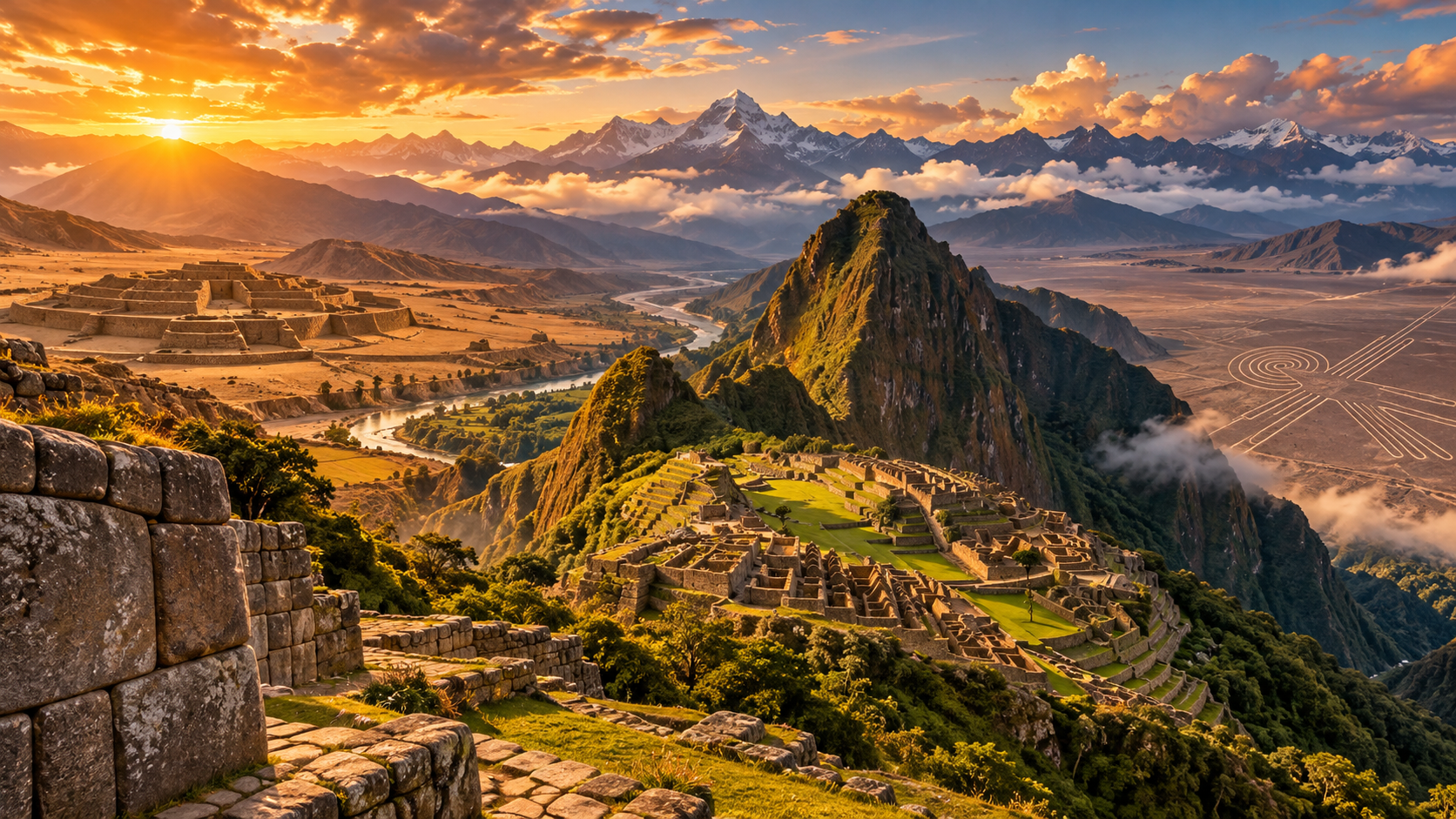
For many travelers, Peru history begins with one image: Machu Picchu sitting high in the Andes.
It is an incredible image.
It is also a very late chapter.
Long before the Inca built roads across the mountains, people on the Peruvian coast were constructing monumental settlements. Civilizations rose in desert valleys, highland basins and river systems. Cities appeared, vanished and were replaced by new powers with different languages, gods, textiles, pottery and political systems.
That is what makes Peru so interesting historically.
The story is not “Inca, then Spain, then modern Peru.”
There are thousands of years packed in before the Inca even arrive.
Caral developed while the pyramids of ancient Egypt were still part of the living world. Chavín influenced communities across the Andes centuries before Rome became an empire. The Moche built huge adobe monuments. The Nazca drew enormous figures into the desert. The Wari created an expansive state long before Cusco became powerful. Chan Chan grew into one of the largest adobe cities on Earth.
Then the Inca appeared.
And even they ruled their vast empire for a surprisingly short time.
Caral Changes the Timeline Completely
The Sacred City of Caral-Supe lies in the Supe Valley north of Lima.
It is one of the oldest known urban centers in the Americas, with development beginning roughly 5,000 years ago.
That date matters because it forces you to rethink the idea that large, organized societies appeared late in the Americas.
Caral included monumental platform structures, sunken circular plazas and planned spaces that suggest a highly organized society.
And there is another interesting detail.
Researchers have found relatively little evidence of warfare compared with many later states. The settlement appears to have depended heavily on trade and cooperation between agricultural valleys and fishing communities along the Pacific coast.
So one of the earliest chapters of Peru history was already tied to the relationship between coast and inland valleys.
That relationship keeps returning for the next several thousand years.
Why Geography Matters So Much in Peru
Look at a map and Peru seems straightforward.
Travel across it and that illusion disappears.
The country contains Pacific desert coast, enormous Andean mountains and Amazon rainforest.
These are not small environmental differences.
They shape food, settlement, transportation and power.
The coast has fertile river valleys surrounded by desert. The Andes have high plateaus, deep valleys and difficult mountain passes. East of the mountains, the land drops into tropical forest.
Ancient societies had to solve very practical problems.
How do you farm in a desert?
How do you move goods across mountains?
How do you store food in places where harvests vary?
How do you control communities separated by enormous elevation changes?
Much of Andean history is really the story of people becoming extremely good at answering those questions.
Chavín Became an Early Religious Center
By roughly the first millennium BCE, Chavín de Huántar had become one of the Andes’ most influential ceremonial centers.
The site sits in a highland valley where routes from different ecological zones could meet.
Its architecture includes plazas, stone structures and interior galleries.
Its art is even stranger.
Carved images mix humans with jaguars, snakes, birds and other animals in forms that can be deliberately difficult to read.
The famous Lanzón, a tall carved stone figure inside the temple complex, remains one of Chavín’s best-known objects.
Chavín probably did not rule Peru as a centralized empire.
Its influence seems to have spread through religion, art and shared elite culture rather than simple military conquest.
Think of it as a powerful cultural language.
Different communities could recognize the symbols even if they lived far apart.
The Nazca Turned the Desert Into a Canvas
South of Lima, the desert around Nazca contains some of Peru’s most mysterious archaeological remains.
The Nazca Lines are huge geoglyphs created by removing darker surface stones to expose lighter ground beneath.
Some designs form straight lines and geometric shapes.
Others depict animals and plants, including a monkey, hummingbird and spider.
The shapes are enormous.
That is where the mystery begins.
Many are easier to understand from above than from ground level.
There is no need to bring aliens into it.
The Nazca people were perfectly capable of creating large-scale designs using planning, ropes, stakes and coordinated labor.
The exact ritual meanings remain debated, but water, pilgrimage and ceremonial activity are all important themes in scholarly interpretations.
The Moche Were Masters of Pottery and Monumental Adobe
On Peru’s northern coast, Moche societies flourished during the first millennium CE.
They built monumental adobe structures, developed sophisticated irrigation systems and produced some of the most expressive pottery in ancient South America.
Moche ceramic vessels show warriors, musicians, animals, supernatural figures and scenes from everyday life.
Some are startlingly realistic.
Others are very explicit.
Museum labels have quite a job sometimes.
The Moche were not one simple unified empire across the entire coast. Different political centers rose and fell.
Important archaeological sites include the Huacas del Sol y de la Luna near Trujillo and the royal tombs discovered at Sipán.
The Lord of Sipán burial, excavated in the 1980s, transformed understanding of Moche elite society because the tomb had remained relatively intact.
Then the Wari Built Something Much Bigger
Between roughly 600 and 1000 CE, the Wari expanded across large areas of the Andes.
Their capital lay near modern Ayacucho.
Wari influence extended through administrative centers, roads, planned settlements and agricultural systems.
They are often described as one of the first large Andean empires.
Their political structure is still debated, but their reach was substantial.
And this matters for the Inca story.
The Inca did not invent every administrative idea from scratch.
Earlier Andean states had already experimented with road systems, highland agriculture, labor organization and regional administration.
History tends to recycle useful ideas.
Tiwanaku Shaped the Southern Andes
At roughly the same time, Tiwanaku developed around Lake Titicaca, mainly in what is now Bolivia but with influence extending into southern Peru.
The high-altitude environment around the lake demanded unusual agricultural solutions.
Raised fields helped manage water and temperature.
Religious and artistic traditions spread across a wide area.
Tiwanaku and Wari were not the same state, but their histories overlap in fascinating ways.
They show that long before the Inca, the Andes already contained powerful regional systems linked through trade, religion and politics.
Chan Chan Became a Giant City of Adobe
After earlier coastal societies declined, the Chimú kingdom became the major power on Peru’s northern coast.
Its capital was Chan Chan near modern Trujillo.
The city was built largely from adobe.
That sounds fragile.
And in some ways it is.
But Chan Chan grew into an enormous urban complex with palaces, plazas, storage areas, ceremonial spaces and decorated walls.
Marine imagery appears repeatedly, which makes sense for a coastal society closely connected to the Pacific.
The Chimú built sophisticated irrigation networks and controlled a long section of the coast.
Eventually, they faced the expanding Inca.
That did not end well for Chimú independence.
| Culture or Period | Approximate Dates | Known For |
|---|---|---|
| Caral-Supe | c. 3000-1800 BCE | Early urban centers and monumental architecture |
| Chavín | c. 900-200 BCE | Religious influence and distinctive stone art |
| Nazca | c. 100 BCE-800 CE | Geoglyphs, ceramics and desert adaptation |
| Moche | c. 100-800 CE | Adobe monuments, irrigation and realistic ceramics |
| Wari | c. 600-1000 CE | Large territorial state and administrative centers |
| Chimú | c. 900-1470 CE | Chan Chan and northern coastal power |
| Inca | c. 1400s-1530s | Vast Andean empire centered on Cusco |
The Inca Arrived Late – and Expanded Very Fast
This is the part that surprises many people.
The Inca Empire was huge.
But its period of major expansion lasted only about a century before the Spanish invasion.
Inca tradition places the origins of the ruling dynasty in Cusco much earlier, but the empire’s explosive territorial growth began mainly in the 15th century.
Pachacuti is usually credited with turning the Kingdom of Cusco into a major imperial power.
His successors expanded farther north and south.
At its height, the empire stretched through much of western South America, covering parts of modern Peru, Ecuador, Bolivia, Chile, Argentina and Colombia.
The Inca called their empire Tawantinsuyu, commonly translated as “Land of the Four Quarters.”
Cusco Was the Center of the Inca World
Cusco was the political and symbolic heart of Tawantinsuyu.
Roads radiated outward from the region.
Royal estates, temples and administrative structures filled the city.
The Temple of the Sun, known as Qorikancha, was among the most important religious sites.
Spanish colonists later built the Church of Santo Domingo over parts of the complex.
That physical layering still defines Cusco today.
You can see Spanish colonial walls sitting directly on precisely fitted Inca stone foundations.
History is literally stacked.
Inca Stonework Deserves the Hype
Some Inca walls use enormous stones cut and fitted together without mortar.
The joints can be incredibly tight.
This was not done because the Inca lacked simpler construction methods.
Different types of buildings used different masonry.
Fine stonework was often associated with important structures.
The design also worked well in an earthquake-prone region because walls could flex and shift without collapsing in the same way as more rigid construction.
Sites such as Sacsayhuamán show just how ambitious this engineering could become.
Some individual stones weigh many tons.
No lost supercivilization required.
Just organization, skill and a lot of labor.
The Inca Road System Connected an Enormous Territory
One of the greatest achievements of the Inca was the Qhapaq Ñan, the vast Andean road system.
Parts of the network predated the Inca, but they expanded and organized it at extraordinary scale.
Roads crossed mountains, deserts and valleys.
Suspension bridges crossed rivers.
Way stations supported travelers and officials.
Messengers known as chasquis carried information rapidly through relay systems.
The network made imperial administration possible across terrain that still challenges modern travelers.
- Roads connected major administrative and religious centers.
- Storehouses helped move and distribute food and supplies.
- Relay runners carried messages across long distances.
- Bridges allowed routes to cross deep rivers and gorges.
- Local labor obligations helped maintain infrastructure.
The system was infrastructure, politics and military logistics all at once.
The Inca Did Not Have an Alphabetic Writing System
This fact sometimes gets phrased incorrectly as “the Inca had no writing.”
More accurate is that they did not use a known alphabetic writing system like Spanish or English.
Instead, administrators used quipu – systems of knotted cords that recorded numerical and possibly more complex information.
Color, knot type and cord arrangement carried meaning.
Quipu were used for accounting, census information, tribute and administration.
Researchers continue studying whether some examples encoded narrative information as well.
So calling them primitive calculators undersells the system.
Machu Picchu Was Probably a Royal Estate
Machu Picchu sits on a mountain ridge above the Urubamba River.
It became Peru’s most famous archaeological site despite being only one part of the wider Inca landscape.
Most scholars connect its construction to the reign of Pachacuti in the 15th century.
The site may have served as a royal estate with religious, agricultural and administrative functions.
Terraces stabilize steep slopes and create agricultural space.
Channels manage water.
Stone buildings align with the dramatic mountain environment.
What makes Machu Picchu memorable is not simply architecture.
It is the relationship between architecture and terrain.
The mountains are part of the design experience.
The Inca Empire Was Already in Trouble When the Spanish Arrived
Francisco Pizarro and a relatively small Spanish force entered Inca territory in the early 1530s.
It is tempting to tell this as a simple story of a few hundred Europeans somehow defeating millions of people.
Reality was messier.
The empire had just suffered a brutal civil war between Atahualpa and Huáscar, rival sons of the former ruler Huayna Capac.
European diseases had also spread through the Americas ahead of direct Spanish contact in some regions, causing major demographic disruption.
And many Indigenous groups resented Inca control.
The Spanish formed alliances with local peoples who had their own reasons to oppose Cusco.
In 1532, the Spanish captured Atahualpa at Cajamarca.
He was later executed despite a huge ransom being collected.
Cusco fell the following year.
Spanish Conquest Did Not Mean Resistance Ended
Inca resistance continued after the fall of Cusco.
Manco Inca initially cooperated with the Spanish but later led a major rebellion.
In 1536, his forces besieged Cusco.
The rebellion failed to retake the city permanently, but resistance continued from a neo-Inca state centered in Vilcabamba.
That state survived until 1572.
The final ruler, Túpac Amaru, was captured and executed.
Even then, Indigenous resistance did not disappear.
It took new forms for centuries.
Colonial Peru Became One of Spain’s Most Important American Possessions
Spain established the Viceroyalty of Peru in the 16th century.
Lima became its political center.
The city was founded by Francisco Pizarro in 1535 on the Pacific coast.
Its location connected the colonial government with maritime trade routes.
Silver became central to the wider colonial economy, especially production from the massive mines at Potosí in present-day Bolivia.
Indigenous communities were subjected to tribute, forced labor systems and major social disruption.
At the same time, Indigenous traditions did not simply disappear.
Languages, religious practices, food, textile traditions and communal organization survived and adapted.
Colonial Peru became a deeply mixed society shaped by Indigenous, European and African populations.
Religion Changed – but Not in a Simple Way
Spanish authorities promoted Catholicism and destroyed or repurposed many Indigenous sacred sites.
Churches were built over important pre-Hispanic spaces.
Missionaries attempted to suppress Indigenous religious practices.
But cultural change rarely works like an on/off switch.
Andean religious ideas blended with Catholic imagery and festivals.
Local saints could become connected with older sacred landscapes.
Mountains remained spiritually important.
Traditional rituals continued in altered forms.
That mixture is still visible in Peruvian festivals today.
Túpac Amaru II Led One of the Largest Colonial Rebellions
In 1780, José Gabriel Condorcanqui, who took the name Túpac Amaru II, launched a major rebellion against colonial authorities.
He claimed descent from the last Inca ruler.
The movement began partly in response to abuses in colonial taxation and labor systems.
It spread across large areas of the Andes.
The uprising was eventually defeated, and Túpac Amaru II was executed in Cusco in 1781.
But his name became a powerful symbol of resistance.
You still encounter it throughout Peruvian cultural memory.
Peru’s Independence Came in Stages
Independence movements swept across Spanish South America in the early 19th century.
José de San Martín entered Lima and proclaimed Peru’s independence in 1821.
But Spanish royalist forces continued controlling large areas.
The decisive military phase came later.
Simón Bolívar and Antonio José de Sucre played important roles in campaigns that culminated with the Battle of Ayacucho in 1824.
That victory effectively ended major Spanish military rule in South America.
So if you see both 1821 and 1824 connected with Peruvian independence, that is why.
One marks the declaration.
The other marks the decisive defeat of royalist power.
The New Republic Did Not Erase Colonial Inequality
Independence created a new country.
It did not instantly create equality.
Political instability marked much of the 19th century.
Power often remained concentrated among relatively small elites.
Many Indigenous communities continued facing economic and political exclusion.
Regional conflicts and military leaders shaped national politics.
At the same time, Peru became deeply connected to global commodity markets.
One of the strangest examples was guano.
Yes, bird droppings.
And they became enormously valuable.
Guano Made Peru Rich for a While
During the 19th century, guano deposits from seabirds along the Peruvian coast became a valuable fertilizer export.
The dry coastal climate helped preserve huge deposits.
European and American agriculture wanted them.
Revenue from guano temporarily provided the Peruvian state with major income.
But dependence on one resource created problems.
Debt, corruption and poor financial management limited the long-term benefits.
The boom eventually faded.
If you have ever wondered whether bird poop could shape a national economy, Peru has your answer.
Yes.
The War of the Pacific Changed Peru Again
From 1879 to 1884, Peru and Bolivia fought Chile in the War of the Pacific.
The conflict centered partly on resource-rich territories along the Pacific coast.
Chile emerged victorious.
Peru suffered occupation, economic damage and territorial losses.
The war remains an important historical memory in the region.
Reconstruction after the conflict took years.
Modern Peru Still Carries All These Historical Layers
Peru today is not simply the descendant of the Inca Empire.
It carries Caral, Chavín, Moche, Nazca, Wari, Chimú, Inca, Spanish colonial and republican histories all at once.
You see those layers in architecture.
You hear them in language.
Spanish is dominant, but Quechua and Aymara remain important, along with numerous Indigenous languages of the Amazon.
You taste the layers in food.
Andean potatoes, maize and chiles meet ingredients and techniques brought through Spanish, African, Chinese and Japanese migration.
Peruvian history is not sitting behind museum glass.
It keeps showing up at lunch.
Peruvian Food Is Basically an Edible History Lesson
Potatoes were domesticated in the Andes thousands of years ago.
Maize has ancient roots.
Quinoa is another Andean crop.
Spanish colonization introduced ingredients such as wheat, cattle, pigs and dairy products.
African communities contributed techniques and dishes during the colonial period.
Chinese migration in the 19th century gave rise to chifa, the Peruvian Chinese culinary tradition.
Japanese immigration helped shape Nikkei cuisine.
- Ceviche reflects Peru’s Pacific geography and long seafood traditions.
- Potatoes connect modern cooking with ancient Andean agriculture.
- Chifa shows the influence of Chinese migration.
- Nikkei cuisine reflects Japanese-Peruvian exchange.
- Anticuchos carry strong colonial and Afro-Peruvian associations.
A menu can contain several centuries of history without explaining any of it.
How Peru’s History Still Shapes Travel Today
If you travel through Peru, you constantly move between eras.
Lima gives you colonial churches and republican architecture but also pre-Hispanic adobe pyramids sitting inside modern neighborhoods.
Cusco contains Inca walls beneath Spanish churches.
The Sacred Valley still has agricultural terraces connected with long Andean farming traditions.
Trujillo gives access to Moche and Chimú sites.
Nazca connects you with desert civilizations.
Caral takes you thousands of years earlier than all of them.
That is why a history-focused Peru trip should not begin and end at Machu Picchu.
| Place | Historical Layer | Why It Matters |
|---|---|---|
| Caral | Archaic period | One of the oldest urban centers in the Americas |
| Chavín de Huántar | Early Horizon | Major religious and cultural center |
| Trujillo region | Moche and Chimú | Adobe monuments and Chan Chan |
| Nazca | Nazca culture | Geoglyphs and desert adaptation |
| Cusco | Inca and colonial | Imperial capital with layered architecture |
| Machu Picchu | Inca | Royal, religious and agricultural complex |
| Lima | Colonial and republican | Capital of the viceroyalty and modern nation |
FAQ About Peru History
Who lived in Peru before the Inca?
Many civilizations flourished before the Inca, including Caral-Supe, Chavín, Nazca, Moche, Wari, Tiwanaku-influenced communities and Chimú. Peru had thousands of years of complex history before Inca expansion.
How old is civilization in Peru?
Large organized settlements such as Caral date back roughly 5,000 years, making the region one of the earliest centers of urban civilization in the Americas.
When did the Inca Empire begin?
Inca rulers were established in the Cusco region earlier, but major imperial expansion began during the 15th century, especially under Pachacuti.
How did the Spanish conquer the Inca?
The Spanish invasion succeeded through a combination of military technology, alliances with Indigenous enemies of the Inca, epidemic disease, internal instability and a recent Inca civil war. Atahualpa was captured in 1532.
When did Peru become independent?
José de San Martín proclaimed independence in Lima in 1821. Major Spanish military resistance continued until the royalist defeat at Ayacucho in 1824.
Why is Machu Picchu important?
Machu Picchu is an exceptional 15th-century Inca site showing sophisticated stonework, water management, terracing and adaptation to steep Andean terrain. It is also one of Peru’s UNESCO World Heritage properties.
How many UNESCO World Heritage Sites are in Peru?
As of 2026, Peru has 13 properties on the UNESCO World Heritage List, including Machu Picchu, Cusco, Caral, Chavín, Chan Chan, the Nasca Lines and the Historic Centre of Lima.
Peru History Makes More Sense When You Stop Starting With Machu Picchu
Machu Picchu deserves its fame.
But it is not the beginning of Peru’s story.
It is almost the opposite.
It belongs to one of the final great civilizations of pre-Hispanic Peru.
Thousands of years earlier, people at Caral were already building monumental architecture.
Chavín turned religion and visual symbolism into a shared cultural language.
Moche artists modeled faces in clay with startling realism.
Nazca communities drew enormous images across a desert.
Wari administrators connected distant regions.
Chimú rulers governed from a massive adobe capital.
Then the Inca took many older Andean ideas and expanded them on a remarkable scale.
Spanish conquest shattered that political system but did not erase the people or their traditions.
Colonial Peru became a place of conflict, exploitation, adaptation and cultural mixing.
Independence changed the government, but many social inequalities survived.
And modern Peru still carries all of those histories.
You can see them in Cusco stonework.
In Quechua words.
In Catholic festivals with Andean roots.
In food made from potatoes domesticated thousands of years ago.
In a Chinese-Peruvian restaurant in Lima.
In textiles whose patterns connect families with specific communities.
That is what makes peru history so much more interesting than a timeline of rulers and battles.
It is layered.
One civilization does not neatly replace the previous one.
Ideas survive. Roads get reused. Sacred places gain new names. Languages adapt. Recipes collect new ingredients.
So when you visit Peru, look beyond the famous ruins.
Go to Machu Picchu, yes.
But remember that the Inca were standing on thousands of years of Andean history themselves.
That deeper timeline is the real story.